
Who Controls Your Heroes? The Danger of Manufactured Heroism
China's campaign to create heroes reminds us why hero status can't be government-issued.

Who are your heroes?
Chances are, they didn’t come from an official government pamphlet. They came from stories that moved you. Those books with broken spines, VHS tapes that wore thin, and moments you witnessed that you’ll never forget.
What happens when a State decides it should choose your heroes for you?
Jocelyn sent me an article last week with some interesting(?) observations from China. China is choosing its heroes. The government carefully curates competitions, school projects, and digital experiences to produce heroes who represent obedience and sacrifice to the State. Children craft paper lanterns with martyrs’ families. Journalists are sent on “immersion” training to get up close and personal with State-sanctioned legends.
It’s not just China. Lots of countries have “hero days”. Russia has Day of Heroes of the Fatherland, Zimbabwe and the Philippines have Heroes’ Day, and various African nations hold Martyrs’ Days. These commemorations can be sincere tributes, but they can also serve as a soft power tool to unify (and control) public sentiment.
When States decide who we admire, hero-status risks becoming a performance piece in service of power rather than a moral compass forged from choices.
Why would a State create heroes? The answer is as old as politics itself. Heroes are symbolic glue. They keep populations focused on shared narratives and values. A State-sanctioned hero embodies the traits that make an ideal citizen. That could be sacrifice, loyalty, or maybe silence when needed.
Achilles in Greece. Rama in India. Jeanne d’Arc in France. Sigurd for the Norse.
Or consider Lei Feng, China’s most famous poster-boy of obedience. He was the subject of the first paper I contributed to with Phil Zimbardo. In the 1960s, his diary (real or imagined - historians still argue) was published, full of selfless devotion to the Communist Party. The slogan “Learn from Comrade Lei Feng” became an annual mantra, pushing people to emulate his unwavering service.
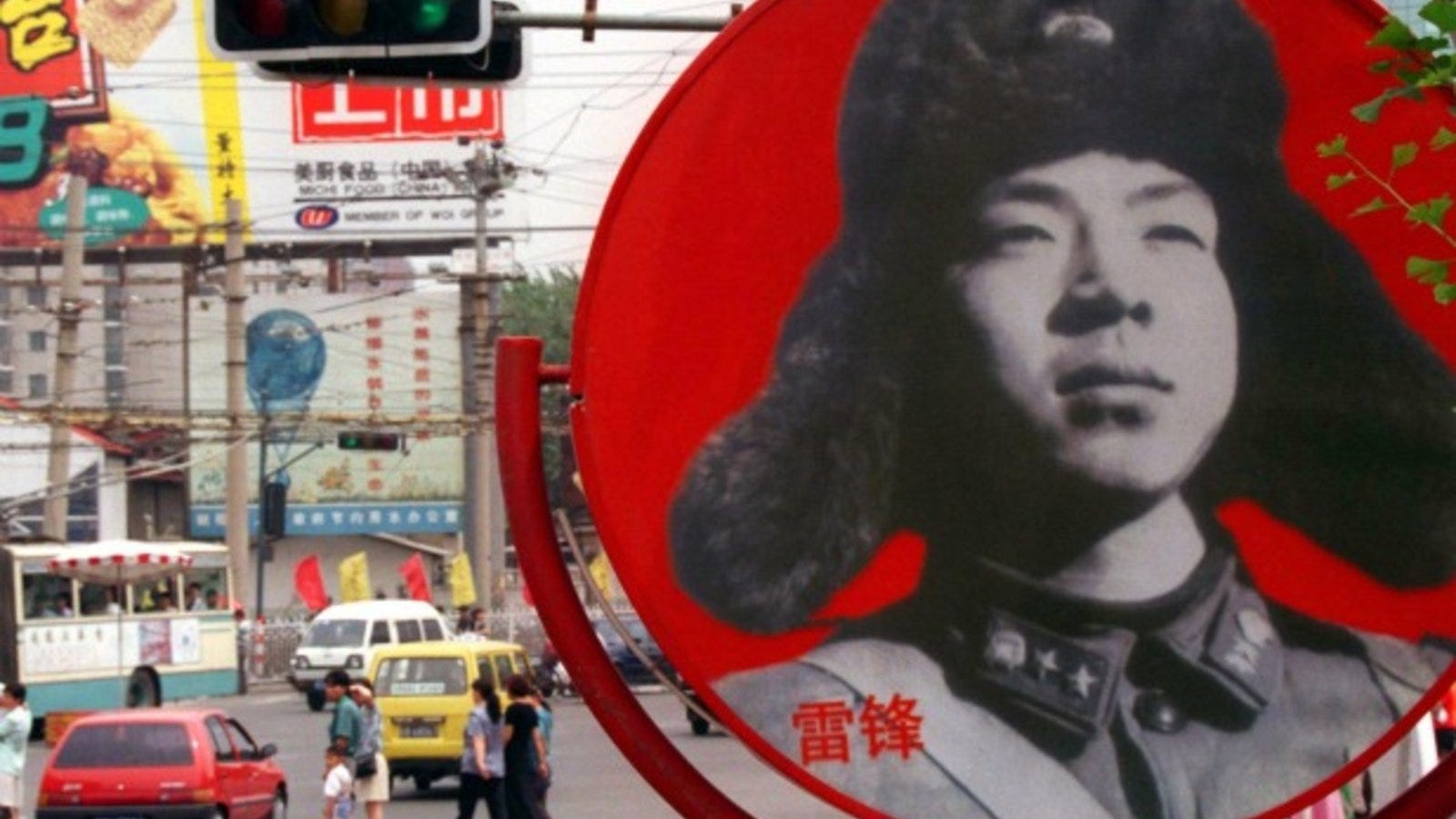
But … when heroes are primarily State-issued, something is lost.
And let’s not get smug. Democracies are not immune. President Trump’s push for a “national garden of American heroes” wants a curated list of statues, selected to promote a very particular vision of American greatness with glaring omissions as well as alarming inclusions. Many European “memory laws” are designed to guard national narratives, often by criminalising certain interpretations of history.
When the State dictates who your heroes should be, it shapes how citizens see themselves. It encourages conformity rather than courage, obedience rather than questioning.
Over the last decade or so, people have started pushing back. We’ve seen this play out in bronze and marble and stone. Across Australia, the UK, and the US, statues have been torn down or defaced. Statues of colonisers, slave owners, traitorous military leaders. These weren’t acts of mindless destruction. They were acts of reclaiming the story of who gets to be a hero.
When the public pulls a statue down, it’s not erasing history. It’s refusing to let the past dictate the present (and future) moral imagination.
When Joe Simon and Jack Kirby created Captain America in 1940, he wasn’t yet a cultural giant. He was a skinny kid from Brooklyn who just wanted to stand up to bullies. Before Pearl Harbor even happened, Captain America was on comic book covers punching Hitler square in the jaw. His message was that sometimes neutrality isn’t moral.
NPR’s recent Throughline episode talked about how Captain America has never been just a flag in very flattering spandex. He’s both a reflection and battleground for American identity itself.
During WWII, Cap served as pure propaganda. He was a super soldier fighting Nazi saboteurs, urging Americans to buy war bonds. After the war, when the enemy became murkier (the Cold War, McCarthyism, civil unrest), Cap’s simple moral clarity stumbled a bit. He was no longer just fighting external monsters. He was battling the American soul. Overdramatic? Probably. But permissible I hope, as we’re talking about a comic book.
Writers like Steve Englehart leaned into this tension in the ’70s. After the Watergate scandal, Cap uncovered corruption at the highest levels of government, forcing him to abandon his persona and become “Nomad,” a man without a country. The symbolism is heavy. What happens when your country betrays the ideals you thought you were defending?
Cap kept changing. He fought student protesters before eventually siding with them. He battled internal threats as much as external ones. In each decade, his story was rewritten, debated, torn apart and stitched back together by creators and fans alike.
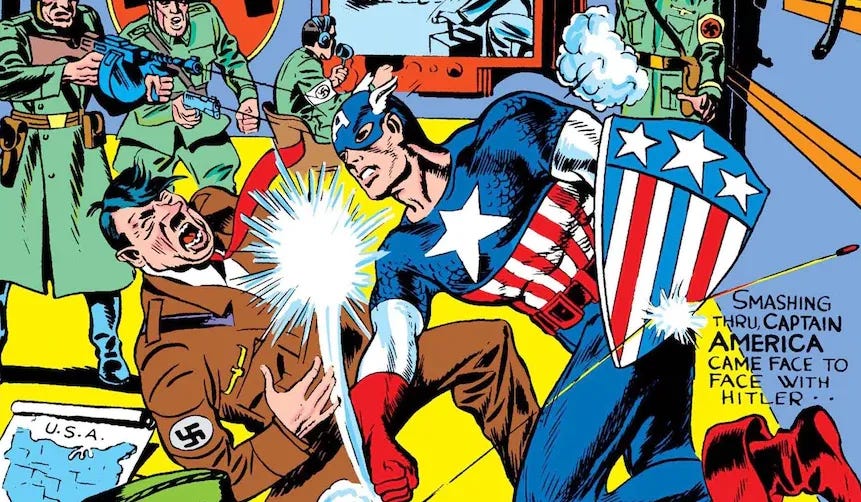
That’s the point. A true hero doesn’t stay stuck, petrified on a plinth. A true hero wrestles with the times, with doubt, with failure. A true hero isn’t handed to you by a State but should be discovered with your own internal compass.
At HIP, we talk about the “banality of heroism.” Real heroism doesn’t arrive draped in flags or endorsed by official holidays. It shows up in small, inconvenient moments.
Governments often want heroes who reinforce the status quo. Real heroes rarely do. In fact, they’re almost always breaking up the status quo. Martin Luther King Jr. was considered a dangerous radical during his lifetime, not a national icon. Captain America was controversial when he sided with anti-war students. The very essence of heroism lies in the willingness to risk comfort and reputation for a higher moral principle.
In a world of pre-packaged “hero days” and carefully manicured stories, we must retain our right to choose our heroes. Heroes aren’t just people we admire. They’re the moral templates we use to decide how we act in crisis, how we treat strangers, what we stand up for. When I ask you who your hero is, your answer speaks volumes about who you are.
Then you should remember that the greatest heroes might not be standing tall for tribute. They might be in a small apartment writing dissenting letters. In a lab fighting for vaccine equity. In a classroom telling the truth when it’s easier to lie. In a comic book panel, wrestling with their country’s (and your) contradictions.
Next time someone offers you a hero, ask who did the choosing. Who profits from your admiration? If that admiration only makes you more obedient, more docile, more willing to overlook injustice, then maybe that person is not a hero. Maybe that person’s a mascot.
~ Matt
The main lesson I can get from this essay is - know thy heroes'.
There are many levels of heroism we can relate to, almost ethereal levels like the saints and prophets that lived what can be considered 'almost perfect lives', there are political heroes, that sacrificed their fortunes and lives for what they believed, there are ideological heroes, media fabricated heroes, real heroes and fake heroes, that is why we should look at everyone in the spotlight with grain of salt, consider their histories and judge by ourselves the worth of their actions, their vices, their virtues and their historical contexts.
I can't say that without noticing that in a democracy we are free to choose our heroes, to judge them, to like them or not like them, to put them in our altars or in the public square, to transform them in posters, images or icons, to see them glowing on LED screens or billboards, and this is a beautiful feature of the liberties we take for granted in a good part of the west. A statue of a freemason in a square in front of catholic temple full of their saints in a city represented by the statue of a pagan goddess is a sign of healthy environment where people can decide what their heroes are.
With that stated, in totalitarian states the people are considered incapable of choosing their heroes, so the state imposes what heroes should be and the people can't choose differently, in North Korea a girl can't put a Tailor Swift poster on her bedroom nor an Icon with the Virgin Mary on her living room wall. when a certain state or ideology have the monopoly on who should or should not be heroes is where the problem resides, that is why tirannies tear down any imagery of what is not approved by the people in power, they burn churches, tear down from the walls any image not approved by the state, break statues and any resemblance of a society with its origins and history, see what the Chinese did in their cultural revolution.
That is why we shall not support the destruction of other people's heroes, because in doing so we deny their dignity and freedom to choose and organize.
Very....very interesting.
I like this question of "who did the choosing?"